Vapor Pressure vs Boiling Point: Essential Differences Explained
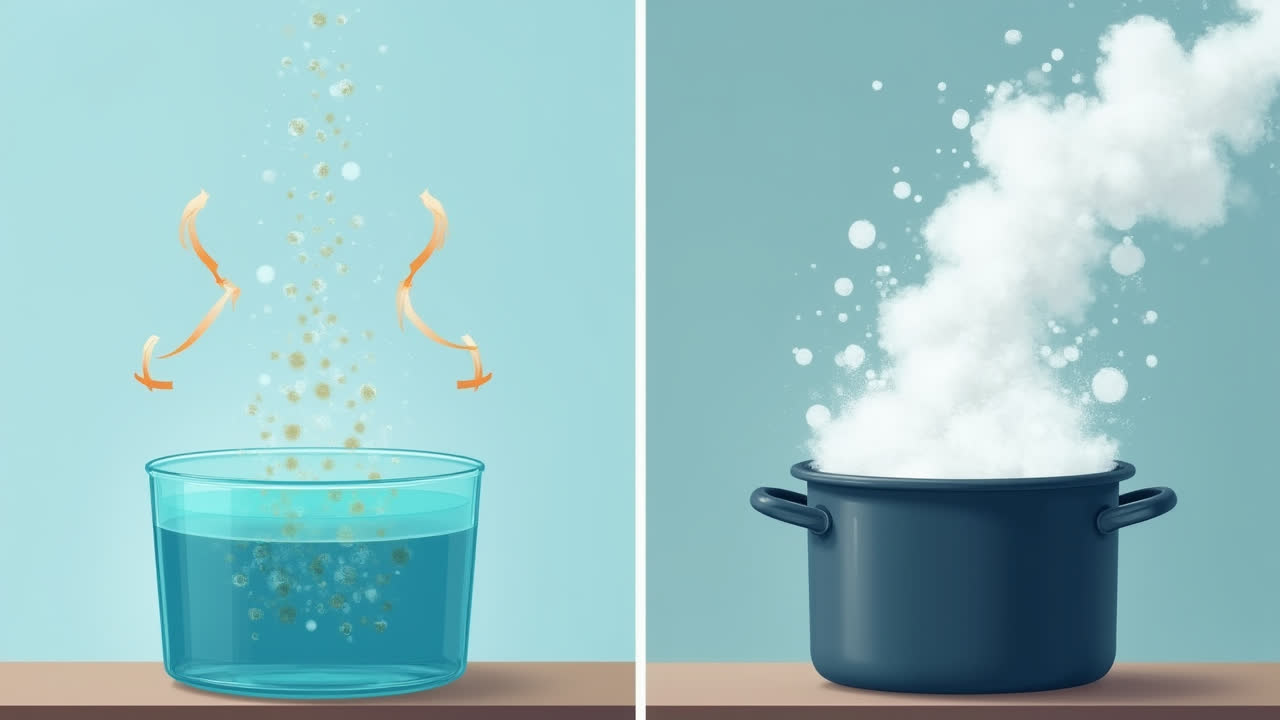
Have you ever wondered why water boils faster at high altitudes? Or why some liquids evaporate quickly at room temperature while others barely evaporate at all? The answers lie in understanding the relationship between vapor pressure and boiling point. While these two concepts are closely related in chemistry, they represent different physical properties that affect countless everyday phenomena and scientific applications.
The difference between vapor pressure and boiling point is fundamentally about what they measure: vapor pressure is a measurement of pressure exerted by a substance's vapor, while boiling point is a measurement of temperature at which a specific phase change occurs. Understanding this distinction helps explain everything from cooking at different elevations to industrial distillation processes.
What is Vapor Pressure?
Vapor pressure can be defined as the pressure exerted by a vapor when it's in equilibrium with its liquid or solid phase at a given temperature. I find it helpful to think of vapor pressure as a measure of a substance's "eagerness" to escape into the gaseous state. Have you noticed how some substances—like rubbing alcohol or gasoline—seem to evaporate almost instantly when exposed to air? That's because they have a high vapor pressure at room temperature.
For vapor pressure to be measured accurately, several conditions must be met. First, the vapor must be in equilibrium with its liquid or solid phase. Second, the system must be at a constant temperature. Third, both the vapor and its condensed form must exist in a closed system. When these conditions are satisfied, we can observe and measure the pressure exerted by the vapor molecules.
The vapor pressure of a substance is directly related to temperature. As temperature increases, molecules gain more kinetic energy, allowing more of them to escape from the liquid or solid phase. This results in a higher vapor pressure. It's a bit like a crowded room getting hotter—as the temperature rises, more people (molecules) will try to leave the room (liquid state). For volatile substances, this exodus happens quite readily even at relatively low temperatures.
An interesting and important point to note is that at a certain temperature, the vapor pressure becomes equal to the external pressure acting on the liquid or solid. This critical temperature is what we call the boiling point—the moment when bubbles of vapor can form throughout the liquid, not just at the surface. I'll always remember my chemistry professor saying, "Boiling isn't just vigorous evaporation—it's when the vapor pressure fights and wins against atmospheric pressure."
Understanding Boiling Point
The boiling point is the temperature at which a liquid transitions to its gaseous state throughout the entire substance, not just at the surface. More specifically, it's the temperature at which the vapor pressure of a liquid equals the external pressure applied to it by the surrounding environment. This is why water boils at different temperatures depending on your elevation—the atmospheric pressure changes with altitude.
I once experienced this phenomenon firsthand while trying to make tea during a hiking trip in the mountains. The water seemed to boil much faster than usual, but my tea tasted weaker. Later I learned that at higher elevations, water boils at lower temperatures because the atmospheric pressure is lower. At sea level, water typically boils at 100°C (212°F), but at an elevation of 10,000 feet, it might boil closer to 90°C (194°F)—not hot enough to extract all the flavors from my tea leaves!
It's important to distinguish between boiling and evaporation. Evaporation occurs at temperatures below the boiling point and primarily affects molecules at the liquid's surface that have enough energy to escape. These surface molecules are only loosely bound to other molecules in the liquid, making their escape relatively easy. During boiling, however, molecules throughout the entire liquid have sufficient energy to overcome the external pressure and escape as vapor.
The boiling point serves as an important physical property for identifying and characterizing substances. In chemistry labs, this property is often used to assess the purity of compounds—impurities typically change a substance's boiling point in predictable ways. In practical applications, understanding boiling points helps engineers design distillation processes, cooling systems, and countless other industrial applications.
Key Differences Between Vapor Pressure and Boiling Point
| Characteristic | Vapor Pressure | Boiling Point |
|---|---|---|
| Definition | Pressure exerted by vapor in equilibrium with its liquid/solid phase | Temperature at which vapor pressure equals external pressure |
| Measurement Unit | Pressure units (Pa, mmHg, atm) | Temperature units (°C, K, °F) |
| System Requirements | Closed system with constant temperature | System with constant pressure |
| Phase States | Relevant to both solid and liquid phases | Primarily relevant to liquid phase |
| Variability | Varies with temperature | Varies with external/atmospheric pressure |
| Practical Application | Predicting evaporation rates, volatility | Distillation, cooking, chemical identification |
| Relationship | Increases with temperature | Decreases as vapor pressure increases |
| Observable Phenomenon | Evaporation, sublimation | Bubbling, rapid phase change |
Practical Applications in Everyday Life
Understanding vapor pressure and boiling point isn't just academic knowledge—it has practical applications that affect our daily lives. For instance, pressure cookers work by increasing the pressure inside the pot, which raises the boiling point of water. This higher temperature cooks food faster and more thoroughly. The opposite happens when you're in the mountains—lower atmospheric pressure means water boils at a lower temperature, making cooking take longer.
The concept of vapor pressure explains why some substances evaporate quickly at room temperature. Perfumes, for example, are designed with compounds that have high vapor pressures so they readily evaporate and release their fragrance into the air. Similarly, the high vapor pressure of rubbing alcohol makes it feel cool on your skin as it rapidly evaporates, absorbing heat in the process.
In industrial settings, these properties are even more critical. Distillation processes separate liquids based on their different boiling points. Petroleum refineries use this principle to separate crude oil into various products like gasoline, diesel, and kerosene. The refrigeration cycle in your fridge manipulates vapor pressure and boiling points of refrigerants to create cooling effects. Even weather forecasting relies on understanding vapor pressure to predict humidity levels and precipitation.
I remember an experiment we did in my college chemistry lab where we measured the vapor pressure of different alcohols at various temperatures. It was fascinating to see how even slight chemical differences—like just one additional carbon atom in the molecular chain—could significantly alter a substance's vapor pressure and boiling point. This principle is why ethanol (drinking alcohol) boils at 78°C while methanol (wood alcohol) boils at 65°C, despite their similar chemical structures.
Factors Affecting Vapor Pressure and Boiling Point
Several factors influence a substance's vapor pressure and boiling point. The strength of intermolecular forces plays a crucial role—substances with stronger forces between molecules generally have lower vapor pressures and higher boiling points. This explains why water, with its hydrogen bonding, has a much higher boiling point than similarly sized molecules like methane.
Molecular weight and surface area also matter. Heavier molecules typically have lower vapor pressures because they require more energy to move from the liquid to the gas phase. Additionally, the presence of impurities can alter both properties. Adding salt to water, for example, raises its boiling point—a phenomenon known as boiling point elevation that comes in handy when cooking pasta.
Environmental conditions significantly impact these properties too. We've already discussed how altitude affects boiling point, but humidity also influences evaporation rates by changing the vapor pressure gradient between a liquid and its surroundings. On humid days, sweat evaporates more slowly from our skin because the air is already saturated with water vapor, making us feel hotter and stickier.
The relationship between temperature and vapor pressure follows an exponential curve rather than a linear one. This means small temperature changes can cause large increases in vapor pressure, especially near a substance's boiling point. This relationship is described mathematically by the Clausius-Clapeyron equation, which helps scientists predict how vapor pressure will change with temperature for specific substances.
Frequently Asked Questions About Vapor Pressure and Boiling Point
Why does water boil at lower temperatures at high altitudes?
Water boils at lower temperatures at high altitudes because atmospheric pressure decreases with elevation. Since boiling occurs when a liquid's vapor pressure equals the external pressure, less atmospheric pressure means water doesn't need to reach as high a temperature before its vapor pressure matches the external pressure. For every 1,000 feet increase in elevation, water's boiling point decreases by about 1.8°F (1°C). This is why cooking instructions often include adjustments for high-altitude locations.
How do vapor pressure and boiling point relate to each other?
Vapor pressure and boiling point are inversely related—substances with higher vapor pressures typically have lower boiling points. This makes sense when you consider that a high vapor pressure means molecules easily escape from the liquid phase. The boiling point is simply the temperature at which a substance's vapor pressure equals the external pressure. We can visualize this relationship on a vapor pressure curve: as temperature increases (x-axis), vapor pressure increases (y-axis), and the point where this curve intersects with the line representing external pressure marks the boiling point.
Why do different liquids have different vapor pressures at the same temperature?
Different liquids have different vapor pressures at the same temperature primarily because of variations in intermolecular forces. Substances with strong attractions between molecules (like hydrogen bonding in water) require more energy for molecules to escape into the vapor phase, resulting in lower vapor pressures. Conversely, substances with weak intermolecular forces (like diethyl ether) have higher vapor pressures. Molecular weight also plays a role—heavier molecules generally have lower vapor pressures because more energy is needed to move them from liquid to gas phase. Additionally, molecular structure affects how molecules can pack together, influencing the ease with which they can escape the liquid state.
Conclusion
The relationship between vapor pressure and boiling point reveals fascinating aspects of how matter behaves during phase changes. While vapor pressure measures the force exerted by vapor molecules in equilibrium with their liquid or solid phase, boiling point marks the critical temperature where this pressure matches external pressure, causing widespread vaporization.
Understanding these concepts helps explain countless natural phenomena and practical applications—from why morning dew evaporates as the day warms up to how distillation separates mixtures in industrial processes. The next time you watch water boil or feel perfume evaporate from your skin, you'll appreciate the intricate physical properties at work.
These principles aren't just academic curiosities. They underpin crucial technologies from refrigeration to petroleum refining, and their practical applications touch our lives in countless ways. Whether you're a student, a cooking enthusiast, or simply curious about the world around you, grasping the relationship between vapor pressure and boiling point offers valuable insights into the behavior of matter.